Friday, June 12, 2009

CI 5472 Post 4 - Media Representations of Race

PART ONE
“Get ready for the pain boy! The pain train is commin’! Whoo whoo!”
-Terry "Terrible Terry" Tate: Office Linebacker

When I read through this week’s blogging task, I immediately, and I mean IMMEDIATELY, thought of Reebok’s “Terry Tate Office Linebacker” series of advertisements originally airing during the 2000 Super Bowl. For years after their original airing, this series of commercials commercials, as well as the very persona of Terry Tate himself, continued to strike my funny bone so intensely that viewing them became a routine while at college parties, hanging out with friends, and / or when I just needed a quick laugh. However, after reading chapter 5 of our course text and further reflecting on what I’ve learned about critical literacies throughout my program, close analysis of Reebok’s 2000 representation of Terry Tate both shape and reflect a highly prejudiced set of assumptions and ideologies regarding African Americans. More specifically, the assumptions that African Americans are inherently efficient at asserting power through violence, fear, and intimidation, and the resulting ideology that this natural ability can "pay off” / be productive if it is controlled / utilized by someone perhaps inherently more in control of themselves and / or intelligent. Furthermore, close analysis of these commercials may reveal the underlying ideology that African American’s need to be / should be controlled because of these inherent qualities; if not controlled, they may threaten to challenge the current white status quo vs. support and perpetuate it. After thinking about Terry Tate, I continued to be reminded of additional examples of African American's represented through this ideological lens including the The A-Team's B.A. Baracus and The Green Mile's John Coffee. Analysis and discussion of each follows.

For those of you who have not viewed the commercials and particular character of Terry Tate (played by Rawson Marshall Thurber) that I’m talking about, let me give you a little more background information. In the fictional reality of the series of advertisements, Ron Felcher, white C.E.O. of the Felcher & Sons corporation (a faceless / purposeless corporation as the viewer never really understands what the company actually does other than stereotypical office work), decides that employee productivity, moral, and the corporation's resulting business are suffering. To “fix” the situation, Felcher's strategy (presumably a well thought out strategy as his fictional status of C.E.O. encourages the viewer to perceive him as a competent business man) is to hire Terry “Terrible Terry” Tate, an extremely large and muscular looking African American man. When brought into the company, Flecher bestows upon him the official title / role of “Office Linebacker.” Terry Tate’s job at Felcher and Sons is very simple; if someone is spotted being “unproductive” during his patrols around the office, Tate delivers a healthy dose of both physical and verbal violence, or what he specifically refers to as "pain," to motivate them to get back on task. Examples of Tate’s overall role in the corporation, as well as his method of physical and verbal violence, can be viewed in the video embedded bellow (3:41).


After you view the short clip, consider specifically how the character of Terry Tate, as well as his boss and superior C.E.O. Ron Fletcher, are represented. In addition to Flecher initially hiring Terry Tate because of the competency with his violence-based "skills" as a motivator, Terry Tate considers himself to be born for the job / role:

"I am an enforcer, man. Don’t nothing go down in my house. It’s what’s in the heart baby. Sure I check a few fools. I give ‘em the pain. But sometimes it’s about intimidation you know. (Laughs). It’s mind games... I just do my job man. I do what my God given abilities allow me to do and I thank Jesus Christ for it every single day. And do I enjoy what I do? (Laughs). Hell yeah!”

Through this specific language, Terry Tate not only accepts, but completely embraces his efficiency with violence, intimidation, fear, and pain as his natural, God-given ability / purpose in life. Although the viewer sees Terry Tate using this violence to exercise control over others (e.g., his office coworkers), his ridiculous title and role of "Officer Linebacker" / enforcer are given to him by his boss, the stereotypical middle-aged, highly education, upper class, white male leader figure. While Terry Tate feels a tremendous sense of self-satisfaction in response to finding a niche in the world perfectly suited to his God-given abilities, his white superior is using him for the purpose of further controlling his subordinates. In other words, although it looks like Terry Tate is the one in control of others, the white C.E.O. exercises his control and leadership through Tate. Terry Tate is nothing more than a tool for the white C.E.O's control. The power he feels that he has over his environment / world is a skillfully crafted illusion.

Also, further consider the representation of C.E.O. Ron Fletcher. In the commercial, the viewer never sees Fletcher working with his subordinates. Instead, the viewer sees isolated shots of him seated behind his desk, hands folded, explaining in an even, calculated tone, with his framed degree clearly displayed over his right should, sitting in his fancy leather chair... his decision to utilize Terry Tate. For example, Felcher is represented as an experienced, competent, and strategic businessman as he cites measurable employee improvement following Terry Tate's employment: “Since terry has been with us, our productivity has gone up 46%. We’re getting more from our employees than ever before.” In other words, if not for Felcher's control, insight, strategic planning, and control of Terry Tate, the viewer may perceive Tate as the stereotypical "dangerous / menace" African American vs. a productive employee. Without Felcher's control, Terry Tate's violence might run the risk of destroying Felcher's power vs. perpetuating it. In other words, the viewer might perceive that Terry Tate is "hurting" the workers vs. helping them as a colleague to "increase their productivity."

In one of the later clips of the series, Felcher decides that if one office linebacker had such an impact on office efficiency, hiring another one would do absolute magic. Putting his plan into action, Felcher "drafts" another employee; Courtney Cate, white Office Linebacker.


The viewer then sees Terry Tate and white counter-part Courtney Cate blast people around during their patrols of the office. However, by the end of the clip, the C.E.O. feels that Courtney Cate's "skills" aren't "refined" enough to "do the job." In other words, he is not acting violent enough. As a result, Courtney Cate is transferred to the less busy Felcher and Son's European office to "hone" his "skills." Although Courtney Cate used, accepted, and embraced violence as his God-given gift identical to Terry Tate, only the African American Tate was taken seriously and considered violent enough for the job by the C.E.O. For example, look back to the first clip where the anonymous white, male worker pleads with Tate for his safety: "Please don't hurt me! Please don't hurt me! (Starts crying)." Because the viewer understands that the African American Terry Tate is "just performing his job" for the good of the company under Felcher's control, they don't take the employee's pleas seriously. What if the viewer did not see Felcher's and / or Courtney Cate's contribution to the commercial and relationships to Terry Tate? Would they perceive Reebok's representation of Terry Tate as a stereotypical violent African American menace? Or a hardworking, loyal worker and contributor to society?


"Answer me before I knock yo' head right off yo' shoulders!"
-B.A. Baracus
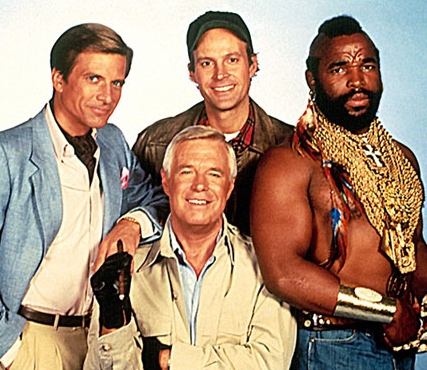

Terry Tate Office Linebacker is not an isolated representation of African Americans as inherently violent beings that need to be controlled. Another popular character represented in such a way is the A-Team's B.A. Baracus played by Mr. T. In fact, the similarities between the representation of Terry Tate and B.A. Baracus are startling. On the level of their specific language use alone, Tate discusses his delivery of "pain" to "fools," while B.A. Baracus uses identical language as he brings "pain" to "suckas" and "fools." Also, identical to Tate, B.A. Baracus is represented as not only accepting, but completely embracing his efficiency with using violence to get the job done and get the A-Team through another ridiculous mission. Just like Tate, any form of talk and / or negotiation takes a back seat to either physical or verbal threats as though they literally come naturally. Finally, focusing on his image alone, B.A. Baracus is represented as exotic, tribal, and / or uncivilized (his hair style, jewelry, facial expressions) in comparison to his "normal / civilized" looking white peers (direct your attention to above images). Like Terry Tate, B.A. Baracus does not fit your description of an average / normal person - even their very appearance (looking big, "wild," and so on) is crafted to portray violence, primitiveness, fear, intimidation, and so on.

Like Terry Tate, B.A.'s violence needs to be mediated by an external force (the remainder of the A-Team) in order to be perceived by the viewer as productive / useful / good to the larger group vs. simply a violent menace. For example, for those of you who aren't fans of the A-Team (my God my nerdiness is coming out in the blog posts), B.A. is deathly afraid of flying. When a mission calls the A-Team to a location in the world reachable only by plane, B.A. absolutely refuses to travel, threatening his peers with physical or verbal violence if they push the issue too far. As a result, the ONLY way that the rest of the A-Team can get B.A. on a plane is to either knock him out, drug him, overtake him, or otherwise control him with force in order to get him to the mission location and later utilize his brute strength to their advantage. Bellow are a series of clips from across the show highlighting the frankly violent, controlling, and disempowering methods that were used by the remaining white members of the A-Team to get B.A. on a plane. As an extreme (or extremely unrealistic, however you want to look at it) example, B.A.'s unconscious body is shown being thrown from a plane with a parachute in order to get him safely to the ground! (YouTube user disabled embedding for some reason, so you'll have to follow the link if you're interested).

http://www.youtube.com/watch?v=3zgQGfBOnh8


"Why, they's angels. Angels just like up in heaven"
-John Coffee

Although certainly not the last example of the phenomena that I'm focusing on, I'd like to discuss one more popular media representation of an African American who needs to be controlled because of his natural, God-given abilities. Adapted to film in 1999, Stephen King's The Green Mile tells the story of John Coffee, an African American wrongfully accused of the rape and murder of two young girls. However, there is something extremely unique about the character of John Coffee; he has magical powers. In addition to John Coffee being represented as hulking, violent, exotic, and so on exactly like Terry Tate and B.A. Baracus (notice how Coffee literally dwarfs the white prison guards with his girth and size in the above image), Coffee has the ability to read people's minds, thoughts, and emotions, transfer his thoughts and emotions to others via his touch, and literally suck the life out of people via bugs that magically come out of his mouth.

However, it's important to point out that some of the previously mentioned assumptions are challenged as John Coffee is represented as a "gentle giant" figure despite the powers that he has. Unlike the representations of Terry Tate and B.A. Baracus, John Coffee is portrayed as being extremely meek, mild, and good at heart. In fact, John Coffee tries to use his powers for good as he desperately tries to save the little girls he was accused of murdering. The stereotypical representation of the naturally prejudice white male figure is also bucked as the white prison guard Paul Edgecomb decides that Coffee is a gift from God, and therefore is beautiful and deserves life. However, Coffee himself requests that he be executed! In addition to the prejudice society who accused him presumably because of his race, size, and presence at the crime scene (where his attempt at resurrection was mistook for murder and rape), Coffee himself believes that he is simply too powerful to "fit in" with the rest of the world. Coffee acknowledges that no force in the world can control him, embracing death to "even out" the great imbalance in power that he perceives. Embedded bellow is the extremely moving scene were Coffee is led to the execution he himself asks for. Overall, despite John Coffee being represented as an inherently gentle vs. violent African American, the above ideology remains intact as he acknowledges the world's inability to control him.


Out of all of these examples, Michael Clark Duncan's portrayal of John Coffee is the ONLY representation of African Americans that does ANY work to challenge common assumptions, asking the viewer to instead ask themselves questions such as: is this right? Does John Coffee deserve this? Do we treat all African Americans in this way? Do we treat all people who do not perfectly align with the accepted norm / status quo in this way? Is this what we want as a society? Is this what we want to teach our children? However, for the remaining two examples, I feel pity for Rawson Marshall Thurber and Mr. T. who decided to star in the roles of Terry Tate and B.A. Baracus respectively because either 1.) they couldn't see / understand the prejudice in the ways that they are being represented / choosing to represent themselves, or even worse 2.) they could see /understand the prejudice and committed to the roles anyways because they were persuaded with the right dollar figure.

At the conclusion of my analysis, I can't help but ask myself, where does / should change actually start? Although I consider myself an individual of pretty high moral standing, I'll be honest; if the price were high enough, I cannot guarantee I would continue to hold fast to my current moral codes. If actors, models, graphic designers, marketers, and other people who make a living off of the representations they produce can be bought into representing WHATEVER is asked of them regardless of their personal morals, values, and beliefs, is focusing change on underlying racial ideologies futile? Or should this change be focused elsewhere? At our economy? At our consumer lifestyle? I know that these systems are interlocking, and that there is no "answer" to such questions, but I think we should be thinking about questions like these as educators.

Finally, to prove that viewers do indeed internalize and perpetuate these, and many other, media representations whether it be race, class, gender, sexuality, and so on as objective reality, check out this piece of Terry Tate fan fiction. "Jackass Generation," oh how many laughs you give to me...


----------------------------------------

PART TWO

Other disciplines that represent the phenomenon I've chosen are the fields of criminal justice / rehabilitation and public health. The link bellow will direct you to a short, easily readable document titled "Race, Ethnicity, and Health Care" produced by the Kaiser Henry J. Family Foundation. Although I understand that this source leans to the public health vs. criminal justice / rehabilitation end of the spectrum, the specific statistics and discussion I found square beautifully with a general discussion of each discipline.

http://www.kff.org/minorityhealth/upload/7541.pdf

If you look at the pie chart in the lower-left column of the first page, notice that young, African American males represent approximately 14% of the American Population (as of 2004). However, as you read on, this source states that young, African American males represent over 40% of the prison population, 7 times that of young, white males. Although I'm not necessarily a numbers person, another anecdotal resource that I found states that approximately 10.4% of the ENTIRE African American male population ages 25 to 29 were incarcerated in 2003 (http://www.infoplease.com/ipa/A0881455.html). In short, It is a gross understatement to say that these numbers are startling.

I would like to think that the criminal justice / rehabilitation system exists, and that people make the choice to enter this particular system, because they have the underlying assumption that individuals who have committed offenses can in fact be rehabilitated and are still "good" human beings. Unfortunately, MANY individuals both within and outside of the rehabilitation system perceive such research findings as the objective evidence that African Americans as a group are IN FACT an inherently violent group of people through an illusory correlation; "If 10.4% of African Americans end up in prison, they surely must be more violent!" As a result, the assumptions and ideologies discussed throughout this blog continue to be accepted / perceived as objective "truths" about our realities. The representations I've included and analyzed throughout PART ONE this posting really make a lot of sense when you place them side-by-side with this illusory correlation; if it is indeed accepted as the "truth" that this is the way this particular group of people simply "are," they will continue to be represented as such, keeping them in the subordinate position perceived as natural for them within our society.

However, direct your attention to some of the other figures found in the Kaiser Foundation article:

-The unemployment rate for young African American men is over twice the rate for young white, Hispanic and Asian men.

-In addition, fewer African American men between the ages of 16 and 29 are in the labor force compared to white, Hispanic and Asian men in the same age group. Over 20% of young African American men live in poverty compared to 18% of Hispanic, 12% of Asian and 10% of white men.

-Fewer than 8% of young African American men have graduated from college compared to 17% of whites and 35% of Asians.

-And the list goes on and on.

Similar to sociology, the discipline of public health assumes that disadvantaged people are at a disadvantage in the first place not because of any personal / natural traits (e.g., being unmotivated, unintelligent, unhealthy, it's what they "deserve"), but because they are in fact put at a disadvantage by a larger interlocking system of oppression designed to exploit them. As a result, ideologies surrounding the discipline of public health include striving together with other disciplines and people to research and understand forces / systems of interlocking oppression in order to raise the social status of disadvantaged people / promote equality because they "deserve" more access to resources (e.g., medical care, employment, education, health specific education, and so on), vs. working to keep them oppressed because they "deserve" less access. The images bellow powerfully represent this ideological difference between the discipline of public health and the overall popular media. To explore this difference, contrast the bellow representations of African Americans generated after an anecdotal google search of the very term "public health" to the images posted in my PART ONE analysis:

In contrast to the images used in PART ONE of this posting, African Americans / marginalized people here are represented as equally intelligent, capable, useful, and otherwise equal to there white peers. They are not represented as violent, hulking, abnormal "others," but normal equals and human beings.

Unfortunately, the creators of popular media texts don't appear to adhere to these particular assumptions and ideologies when representing African Americans (as well as other marginalized groups) in the media. In my opinion, the reasons behind this trend are very simple as well; it takes some brain power and effort to question and try to understand the complexities our reality. By nature, human beings accept / take the path of least resistance, finding it much easier to accept / support the already in place status quo vs. critically analyze, challenge, and evaluate it against complex ideas of equality, justice, and so on. Rather than asking "Is this way of life promoting what I think is just, fair, equal...?" it is MUCH, MUCH easier to say "Well, it's just the way it is, what can I do?" And when you mix in the almighty dollar, people become even more complacent, including the people / groups who are the very objects of discrimination!

To conclude this extremely long posting (thank you so much for reading), this is why I decided to put forth the work to go into the field of teaching, as well as support media studies in general; it is my goal to give students the tools to critically identify, question, reveal, and evaluate the underlying assumptions and ideologies of our complex world in order for them to judge whether or not they are compatible with where they want to "end up" in this life. As a teacher, it is not my job to teach them where I think they should "end up." I have my agenda, and they have theirs. However, I do believe that it IS my job to provide the tools necessary for them to make the most informed choices as possible based on the personal agendas that they do have, whatever they may be. It is my goal to give them the tools necessary for them to perceive that they can in fact change conditions they perceive as unjust vs. being oblivious to them, or worse, accepting them.

Thank you again for reading, watching, and listening.

Tuesday, June 9, 2009

CI 5472 Post 3 - Film Techniques - Film Analysis, Ad. Analysis, and Teaching Techniques

PART ONE (Film Analysis)

The Scene that I am choosing to analyze for this portion of the assignment is what I believe to be one of the most powerful moments from season 6 of the hit HBO series The Sopranos. In this scene, the newly “made man” Christopher Moltisanti (played by Michael Imperioli) is finally confronted by his girlfriend, mother, and extended “family” of fellow mobsters regarding his addiction to drugs. To give the reader further background context, Christopher Moltisanti is the nephew and right-hand-man of mob boss Tony Soprano (played by James Gandolfini). Throughout season’s 1-6, it is Tony’s goal to mold Christopher after himself, teaching him all that he needs to know to one day take over Tony’s successful and vast crime empire. Under Tony’s “mentorship,” Christopher proves himself to be an extremely efficient mobster as he is as ruthless, manipulative, and violent as his mentor Tony. However, there is one small detail that is impeding Christopher’s progress to becoming the “perfect” mobster; his growing addiction to the drugs that he is responsible for pushing throughout New Jersey’s underbelly. As the story line progresses, Christopher’s addiction causes him to make “slip ups” that members of the mafia under close FBI scrutiny cannot afford to have (e.g., flying off the handle and shooting a bakery worker in the foot, flying off the handle and killing a host at a restaurant, “knocking off” shipments off various things such as cigarettes, computers, and so and revealing his identity to the drivers, abusing his girlfriend, and the list goes on and on). In short, Christopher’s drug abuse causes him to become a “sloppy” criminal who is clearly not ready for the position of “family” boss. In the scene previous to the intervention scene, the high on heroin Christopher accidentally sits on and kills his girlfriend Adriana La Cerva's small dog. This was the straw that broke the camel’s back as Adriana (played by Drea De Matteo) decides to take no more of her boyfriend’s drug abuse and tries to help him. In response, she visits Tony who helps her set up the intervention.

Throughout this extremely short scene, the combination of camera shots, lighting, sound (or rather the absence of sound), and editing techniques are effectively used to place the viewer in Christopher’s place, essentially allowing them to experience the anger, discomfort, disappointment, and additional emotions of the intervention for themselves. Also, the combination of these techniques effectively emphasizes the unusual “norms” that the hyper violent, yet concerned family operate with. As a result, the viewer's typical concept of "family" is disrupted, leaving them questioning what is "family"? What does it mean to "love" one another? What it is the best / most effective way to show this love? And what is the "best" / most effective way to help a family member in some sort of need? Tough or tender love? And so on.


The scene opens up very “tight” with a medium close-up of Christopher’s bedroom door. The door then opens up to reveal a medium close-up of Christopher himself. The camera is positioned just close enough to see his deteriorating condition (his dirty shirt, unshaven face), as well as the surprise on his face at what exactly he sees. However, the camera isn’t quite close enough to his face to infer the exact emotion, and ultimately what exactly is causing him such surprise. Before cutting to what he is indeed seeing, he then exclaims “What the Fuck?” as he scans back and forth. Underlighting in this portion of the scene is also used complement the feeling of mystery / suspense at what Christopher is looking at. Christopher himself is also underlit to emphasize his deteriorating condition as a drug addict by making him look dark, sleepy, gloomy, and like this is his first emergence from the solitude of his room in days. In other words, this lighting contributes to Christopher looking like he is very in need of some kind of help. Overall, the shot and lighting of this portion of the scene give the viewer just enough information to create suspense and emphasize Christopher’s deteriorating condition / need of help, yet not quite enough information to figure out exactly what is going on.

The camera then cuts to a wide shot of the answer to Christopher’s surprise; his entire “family” (members of his actual family including his mother and girlfriend, as well as his family of fellow mobsters) seated in uncomfortable looking folding chairs arranged in a circle in the living room. The wide shot produces a feeling of discomfort as the wide angle shot makes it look like everyone Is literally “squeezed” into the room. Also, the shot is a slight high shot, as the camera is slightly looking down on the family, producing the feeling of discomfort and “smallness” as they confront the task at hand; confronting Christopher himself. Furthermore, the viewer can barely make out non-verbal signals of discomfort including the moving of hands in laps, uncomfortable looking faces, and wandering eyes. However, the shot is too wide to see these things with complete clarity, so the viewer is again given just enough information to get a basic idea of what is going on, yet not enough to feel totally secure / comfortable about it; exactly how Christopher presumably feels in reaction to what he is experiencing.

Shots then rapidly intercut between additional medium close-ups of Christopher and his family as they begin to reveal why they are there. For example, there is a shot of the intervention moderator standing up to greet Christopher, saying that everyone has gathered to talk about his drug problem. The camera then immediately cuts back to Christopher asking “What?” and then to Tony commanding Christopher to “SIT DOWN” in a stern voice. Also, I should note that a number of these shot combinations are over-the-shoulder (from Christopher's perspective), to reverse-angle, back to over the shoulder. Through the use of these particular shot combinations, the viewer experiences the scene through Christopher’s point of view as the family begins to judge him. The rapid intercutting from Christopher, to family member, back to Christopher, and repeat emphasizes the feelings of being on trial, as well as Christopher’s confused cognitions as he struggle’ to comprehend what is going on.

While all of this is occurring, the scene is nearly void of sound. Other than the sounds of uncomfortable metal chairs squeaking and people lightly clearing throats, you could hear a pin drop in the room. Together with the above camera shots, these solitary human sound effects emphasize and further help to let the viewer experience the overall discomfort in the room. In this silence, the camera then cuts around to additional mid close-up shots of the rest of Christopher’s family. Again, using underlighting, the viewer is able to just barely gather nonverbal information of the family members (uncomfortable and disapproving looks on faces), yet not quite enough to know exactly what they are thinking; presumably what is going through Christopher’s mind at that moment. This lighting also helps to emphasize the gloomy, uncertain, and fearful overall mood of the scene. Christopher then objects, saying "Fuck this" with a wave of his hands, and the character Paulie Walnuts (played by Tony Sirico) slowly stands up, points at him, and tells him in a firm voice to "SIT DOWN." As Paulie stands up, the camera slowly tilts up to follow the rising motion of his body, making Paulie appear to be extremely powerful and intimidating to both Christopher and the viewer.

The intervention then begins and dialogue filled medium close-up, over-the-shoulder, and reverse-angle shots continue to intercut back and forth between Christopher and his family as people go around the circle and share with Christopher how his drug use has impacted their lives and "business." As Christopher continues to become more and more agitated, his speech and language move from a merely biting tone, to posessing a violently explicit edge. Christopher’s family reacts accordingly. For example, in a medium close-up of Tony, the viewer sees and hears him yell “I'M FUCKIN WARNIN YOU CHRISTOPHER!” in response to Christopher nearly spilling information of a murder in front of the intervention moderator; an "outsider" to the families "business." In this shot, the viewer can literally see and feel the tension on Tony’s face and in his voice. The viewer can also clearly experience Tony’s anger as he points at the camera (Christopher or the viewer), with spit flying out of his mouth as he yells. Throughout the entire series, the viewer is both repulsed and engaged by the conflict between the acidity of such speech / actions, and the deep care and love the family clearly has for each other. In short, this type of communication is “normal” for this family, and all of the above film techniques help the viewer become an “insider” in this bizarre family. It is then left up to the viewer to reconcile the concept of family / familial love as portrayed in the show with their own, and question if such violent love is even possible or "right."

At the climax of the scene, Christopher takes it way too far and Paulie, gets up, grabs Christopher by the shirt, punches him in the face, and knocks him off of his folding chair. The moment after he hits the ground, the remainder of the family jumps up and starts beating the living hell out of him. At the moment that Paulie grabs Christopher by the collar of his shirt, the camera quickly cuts between extreme close-ups of each character’s face. The effect that this creates is that the viewer can literally experience the fear from Christopher’s perspective, as well as see the feral anger in Paulie’s eyes. While the remainder of the family beats the downed Christopher, the camera cuts between wide angel high shots of the action and extreme close ups of feet and legs making contact with Christopher’s body, creating the effect of getting a “birds eye” view of the fight, as well as experiencing the sharp blows from Christopher’s perspective. Accompanying the beating are the sounds of feet stomping, flesh being kicked, the women of the group screaming, and the men swearing each other, all working together to enhance the sensation of pure chaos.

The camera then transitions to a medium, two-shot of Tony sitting across from Christopher in the hospital, telling him in a stern voice that he “will” go to rehab “for the family,” in a firm, yet tender and concerned voice, with Christopher apologizing and crying. Again, this transition juxtaposes the previous violence with the true concern and tenderness that the family shows each other. Overall, the viewer is left wondering if a family with such extreme dynamics can possibly exist, and if this perhaps the "best" / most effective way to help someone with a drug problem despite the brutality of such a method.

----------------------------------------

PART TWO (Ad analysis)


Embedded above is a PERFECT video to use when talking about gender representations in the media (I recently used it during my media studies unit with my two groups of seniors and it worked EXTREMELY well with getting them thinking about gender stereotypes / portrayals in advertisements.)

The link posted bellow will take you to a shot-by-shot analysis of the ad.

http://docs.google.com/View?id=dd429dsq_339z93hzdx

----------------------------------------

PART THREE (Teaching Techniques)

For this third and final section of the assignment, I'd like to share with everyone the way I taught camera techniques during the media unit of my student teaching.

As I sat down and began to work out a unit plan, I literally had NO IDEA where to begin having 1.) never taught before, and 2.) never taught a media unit before. I simply googled the phrase "teaching media studies," and an absolutely life saving resource popped up; I've linked to it bellow.

http://www.texascollaborative.org/BoerckerModule/sec1.php


Titled Visual Rhetoric: Using Advertising Analysis for Reading and Writing Courses, this is an entire unit focusing on visual literacies in advertising (a wonderful pre-exposure to this class), created by Laura Boercker, an instructor at North Harris Montgomery Community College in Texas. As similar to our focus of study for this assignment, Boercker provides her students with the basic film grammar of camera techniques to explore how the audience is "potitioned" in relation to the subject(s) of the ad, and the subsequent cumulative meaning created. In addition to camera orientation, Boercker also talks about the idea of eye gaze (where the eyes of the subject are leading the viewer), something that we did not touch on in CI 5472, and how the use of direct eye gaze (subject looking directly at the camera / viewer), and indirect eye gaze (subject looking at other subjects / objects) influences the meaning of a visual text.

Although Boercker provides a fantastic vocabulary for begininng to critically analyze advertisements, she provides almost no guidance in what type of activities pair best with this vocabulary. As such, I was on my own to create some kind of activity to have my students learn, apply, and transfer this vocabulary to other tasks. Here's what I came up with, and I must say it worked out EXTREMELY well.

First, I simply printed off the text packet of vocabulary definitions that Boercker includes in her unit (see site). I then gave a brief lecture verbally describing these definitions, the effect / meaning that each is used to create, and examples of each.

From there, I split the students up into groups of six giving each group ONE of the following images representing a range of camera orientation and types of eye gaze:


Once students were in groups, it was there task to 1.) identify what type(s) of camera orientation and eye gazes were being utilized and 2.) identify the end result, effect, and potential purpose the creators of the ad had in mind during the design process of each ad. Students then worked in groups on this task. Once they were finished, I projected each individual image to the entire class, and each group did mini-presentations of their conclusions to the rest of the class. As a result, students got the opportunity to zero in on one specific ad, as well as see 5 other examples and hear the reasoning behind how their peers concluded what they did about each ad. For example, I recall the group with the image of the girl with the fish hook in her lip making the following conclusions saying something like: this is a close up shot of a girl with a fish hook in her mouth. Her eye gaze is indirect as she is looking off to the upper left corner of the screen. Her eye gaze, as well as the line from the fish hook makes us ask questions like "Who is on the other end of the hook? Why are they doing this to her?" Judging by the look on her face, this also looks uncomfortable. The text in the ad says "The average smoker smokes over 5000 cigarettes a year." When we compare this with what is going on in the image, it doesn't look like she chose to get "hooked" on cigarettes. Maybe it's the tobacco companies on the other end of the hook? The text paired with this image also suggests that many other people are "hooked" on cigarettes just like this girl. What will happen when she gets "reeled in"? Will she be killed like a real fish (but in this case by cigarettes?... and so on and so forth.


For homework, it was then students' task to find a print ad out of a magazine / off of the internet and do the same analysis on there own (by this time, they've had me explain it, talked through it with their peers, and had their peers explain it back to them). They then wrote a short paper for their analysis which I graded.

All in all, a VERY successful activity. Also, be sure to pick bizarre images or use the ones I've provided (like the fish hook girl). Although it grossed them out a bit at first, the sheer strangeness of it was enough to grab and hold their interest.

Thanks for reading such a long post!

CI 5472 Post (for fun) 2.5.3 - Not So Quick Crack at Podcasting: Problem Solving Strategies / Literacies in Video Games

Bellow is my first crack at podcasting and working with Audicity. As such, the audio quality isn't great, but it does the job. Also, as I reflect on this experience, it would really help to plan things out before recording (go figure). Basically, I apologize in advance for some of the stuttering... it still rocks! I promise you.

In the podcast I spend time discussing how Professor Beach's idea of games teaching / exercising "problem solving strategies / literacies" relates to the Xbox title Splinter Cell: Double Agent - a great example of a game exercising the types of problem solving strategies / literacies that Professor Beach is talking about. Because I couldn't figure out how to upload the audio alone, I quickly created a movie and paired some art and images from the game with my audio. Nothing fancy, but it will help give you a little bit greater sense of what the game is all about. Also, embedded bellow is an official review of the game if you want further information.

Thanks for reading, listening, and watching!


The official video review from Gamespot.

Sunday, June 7, 2009

CI 5472 Post (for fun) 2.5.2 - The Future of Entertainment / Gaming?

In chapter two of our course text, Professor Beach justifies the exploration of video games in the education setting as he states, "Through engaging in video games... students acquire various problem-solving strategies. The level and nature of problem solving varies according to the type of the game; "fighter" / "shooter" games involve mostly defensive, survival strategies, while "God games" involve improvised ways of coping with more complex problems... In participating in games, students are also acquiring different scenarios or narratives for coping with challenges and conflicts... These problem-solving literacies transfer over to students' academic work" (14-15). Although I don't believe that ALL games hold a value transferable to the classroom (for example, I have a hard time accepting that children are learning when they rob and kill prostitutes in the Grand Theft Auto series), I couldn't help but begin to think about how the ever increasing ability for developers to "bring us into" the "world" of the game via technology stands to influence the ways in which we learn / exercise potentially valuable problem solving strategies / literacies.

Since the breakout of the Nintendo entertainment system in the 1980s, the gaming formula has been something like couch + controller + pizza box = entertainment. However, this extremely sedentary and individualistic paradigm of game development is undergoing great transformation as developers are introducing body motion / physical activity (in addition to everything that the Nintendo Wii has to offer, think of games such as DDR, Guitar Hero, Rock Band, and the list goes on and on). Furthermore, with these kinesthetic-based games, the video gaming experience is no longer restricted to playing completely by the self. In fact, these games are often the centers of social activity at many parties and gatherings as people dance, sing, play instruments, golf, and otherwise "act out" the game. As Professor Beach continues to state, while using these new gaming technologies, "...game players are learning a range of social skills through this vicarious participation that assist them in coping with lived-world challenges" (15).

I can't help but ask myself "what's next?" when it comes to technology, and where gaming in particular can go. The videos bellow are examples of an incredible motion-based technology currently in development that I imagine will continue to transform the way we game / learn / socialize. As you watch these real, working technology demos, consider the educational possibilities as students could...

-design and wear virtual costumes for virtual role-plays, allowing them to even more sharply experiencing the particular role.

-design and navigate through virtual spaces for virtual role-plays.

-do the previous with students across the globe.

-select and read virtual books from virtual libraries.

-take virtual drivers ed.

-the list goes on and on.

The possibilities are truly endless. Please take the time to watch the tech demos bellow. They will absolutely blow you away. I apologies for the ads, but I assure you they are short.


Thursday, June 4, 2009

CI 5472 Post (for fun) 2.5.1 - Shiver Me Timbers: Big Whiskey and the Groogrux King

For all of you in our class who are fans of the Dave Matthews Band, their new album uniquely titled Big Whiskey and the Groogrux King was released this week in the United States (I told you I'd weave DMB into my posts). If you're like me and didn't want to spend the extra 6 dollars to get the DVD edition of the album with the in-studio footage of the band discussing and making the album, I have embedded all three full-length parts bellow.

As related specifically to our class, where do we fall as instructors / what is our role when it comes to teaching literacies (e.g., manipulation of audio and video) that may potentially be used for illegal purposes (e.g., copyright infringement and pirating)? Do we explicitly address the subject, telling our students to use the "power" for good vs. evil? If so, think of all of the additional teachable moments that could come out of such a discussion including media / copyright law, ethics, and so on. Or do we not bring it up for fear of planting the seed for students to use their literacies for illegal purposes? After all, the videos that I have embedded into this blog posting where initially "ripped" from the DVD (a DVD that I'm not paying money to view and share with you right now), in order to upload to YouTube in the first place. Also, after being taught be a fellow cohort member it is well within my power to convert these YouTube files into a form that I can burn onto a disk and play in my own DVD player, therefore making a copy of the disk... not that I would do such a thing.

Also, as related specifically to our class, where do we fall when it comes to using potentially "pirated" material for instructional purposes. For example, during my media studies unit, I used MANY clips of popular television shows including Family Guy, Everybody Loves Raymond, the Simpsons, and so on, that where most likely illegal "rips."

Anyways, by my embedding of the following content you can get a glimpse of my particular stance on the questions I've posed. What does everyone else think?

Enjoy the pirated videos everyone. Aaargh!


Wednesday, June 3, 2009

CI 5472 Post 2 - Teaching Media Studies Rationale

To begin by giving the reader of this assignment some context for the remainder of this post and my following rationale, Simley High School located in Inver Grove Heights, MN (where I am wrapping up my student teaching experience at), resembles the scenario described in this blog assignment in a number of ways. Although I didn’t notice a particularly huge concern for improving past poor performance on the MCA II, I none-the-less felt the pressure of returning “back to the basics” to prep my group of sophomores for the spring trimester test. Although I was never necessarily told that I "couldn’t" use new media texts and technology to do so, I felt the pressure to rely on the course’s main, required text to accomplish this “back to the basics” MCA II prep. Furthermore, although there was already some time set aside for me to spend three to four weeks on a media studies unit with my group of seniors, I felt that my access to technology at Simley was extremely limited. For example, it was rather difficult to get my hands on an LCD projector, and I was completely on my own when it came to any kind of speakers. As such, although what sounded to be a previously interesting / successful unit, the media studies unit that my cooperating teacher taught in the past relied on what we might consider to be “traditional” media including print-based literature, CDs for music / audio, TV VCR / DVD combo for viewing, and so on.

Now, on to the assigned rationale...
Description (partially fictionalized) of current curriculum / attitudes
Communications 10

Although both the regular and honors sections of comm. 10 students tend to do well / appear to be fairly well prepared for the MCA II tests, the essentials students are another matter. Although the poor performance of the essentials students doesn’t necessarily put the school at risk for failing to meet AYP, something has to be done to improve the tests scores and overall “literacies” of this group of at risk students.

Currently, Simley’s only required text for all sections of comm. 10 (essentials, regular, AND honors) is an anthology-style textbook titled The Language of Literature, which is organized chronologically from literature spanning from the approximate formation of the United States, to contemporary American society.

In Simley's push to go “back to the basics” in order to boost the scores of the essentials students, teachers have been given instructions and a set of handouts requiring them to frame these texts through a lens of common items tested for on the MCA II including: alliteration, diction, figurative language, imagery, irony, main idea, metaphor, oxymoron, onomatopoeia, personification, simile, supporting evidence, symbol, theme, tone, understatement. In other words, teachers are required to reduce their instruction of the required course text to the identification and discussion of these pieces of knowledge common to being assessed on the MCA II.

Out of fear for the continuing poor performance of the essentials students, as well as the ease of using the simple framework described above provided to them, teachers and reluctant to digress from said plan by focusing on media texts / technologies. Furthermore, Simley’s limited access to technology (projectors and smart boards are given ONLY to AP classrooms) makes such a digression sound even less attractive and productive to teachers.

As for the school’s outside community, parents are reluctant to support the teaching of media texts / technology as they are in fear that their children need “the basics” (basic literacies) before they are ready for the remainder of their high school years, let alone “added on” content. As such, parents find the framework described above as an extremely attractive, efficient, and perhaps most important “quick” way to help their children.

Communications 12


Although three to four weeks are devoted to a media studies unit during the final trimester of students’ experience at Simley, teachers find it difficult to create an engaging, quality unit as it is so difficult to get their hands on the adequate technologies to do so. As such, teachers find themselves falling back on traditional, MCA II prep-style lessons and texts during this unit. Students often find these texts uninteresting, but teachers feel that they are left with no other options. In response, students do their best to struggle to find the motivation to “make it through” the work and graduate.

Because these students are in the final trimester of their high school experience, many parents and teachers alike adopt a “they’ll get what they get and that’s good enough” attitude toward this instruction going on so late in the year. As a result, there is little push for change including investing in more technologies to allow teachers and students to access more content.

----------------------------------------

Rationale
Members of the board,

A number of students in our language arts program here at Simley are at a danger of performing poorly on the upcoming MCA II tests. In response, the district’s decision has been to remediate instruction, reducing the teaching of texts down to what students will most likely be asked to do on the upcoming MCA IIs. Furthermore, time and funding to integrate media studies into the curriculum have been reduced as they are viewed as not being helpful / relevant to helping students perform well on the upcoming standardized test. Although I agree that these students still have not developed the set of literacies necessary for them to perform adequately on not only the MCA IIs, but throughout their lives in general, remediating instruction and continuing to deemphasize media studies is not the answer for the following reasons.

In his book titled A Web-Linked Guide to Resources and activities, University of Minnesota curriculum and instruction professor Rick Beach states that “marginalization of the media in the curriculum ignores the centrality of media in our live; one study found that on an average day, people spend about two-thirds of their waking hours interacting with media, more time than they devote to sleeping, eating, or work” (2). Although I couldn’t agree more with Professor Beach, I feel that describing the media as “central” to our students’ lives is a gross misunderstatement of the role that media plays not only in American, but global life. In addition to the facts that Professor Beach uses to support his claim regarding the role of the media in our lives, Vicki Rideout of the Kaiser Family Foundation states, “children and teens are spending with media and its messages. An average of six and a half hours a day, seven days a week. That’s the equivalent of a full-time job plus a few hours for overtime. And it’s more time than they spend in any other activity besides sleeping, including going to school.” Taking these findings into consideration, I argue that understanding / being literate with the media is not only “central,” but absolutely “fundamental” to students’ current and future success, as well as developing the particular literacies necessary for success in school and function in the larger society.

As Professor Beach continues, a large and positive educational implication to students spending so much time with the media is that it is well within our power as educators “to extend the active participation in and construction of media in the home to the classroom” (3). The fact is that our children have already become “experts” / extremely literate with maximizing their learning through their use of the media / media tools at home (e.g., finding relevant information, sharing and distributing information, analyzing and critiquing information, creating information, and so on), and not providing them the chance to exercise these particular new / media literacies in the classroom to help them refine the literacies necessary to do well on a standardized test / in the larger society is counterproductive. You fear that focusing on media studies is a “digression” and not helpful / productive to learning the literacies needed to do well on standardized tests / in life. I argue the opposite; remediating instruction is the real digression and disservice to further developing the new / media literacies (e.g., finding information, sharing and distributing information, analyzing and critiquing information, and creating new information) required of our students as they enter society.

In a panel discussion hosted by the Kaiser Family Foundation on the role of the media in our lives, Dr. Don Roberts states, “There’s pretty good evidence in the literature and has been for some time that kids cannot not learn when they watch television or read a book or play a video game. Models teach kids. Kids have always learned from models, whether it was dad showing them how to sharpen an ax or whether it’s Common showing them how to get tested. Kids learn from these messages. The issue is not the time; the issue is what they’re learning with that time.” Although this statement was originally given in response to a question regarding the media influencing children to commit violent acts, consider the educational implications. The key word that I would like to take a moment to discuss that both Rideout and Roberts use is “message.” If the messages going "in" (both what we expect our students to learn, as well as our specific instructional practices / delivery regarding how we expect them to learn) are junk, then they will likewise learn junk. If the messages going "in" (both what we expect our students to learn, as well as our specific instructional practices / delivery regarding how we expect them to learn) are properly aligned with our instructional goals, exercising students’ current competency with and further developing new / media literacies via media studies will prepare them for far more than doing well on an isolated standardized test.

However, please do not assume that I am saying that students need no further training / experience with developing the literacies that they are acquiring. As Professor Beach continues to state, “simply watching a TV drama in the bedroom is very different from actively formulating messages…” (2). In other words, there is a HUGE difference between passively viewing the media (having the teacher pop in a video), and actively analyzing, evaluating, and critically thinking about what is viewed. The later is what I am advocating as students’ already forming competency with discussing, critiquing, evaluating, discussing, and producing more media for social change is a benefit to ALL instruction. However, like anything else, the teacher’s role will then be to act as the “coach” in moving students to this higher level of analysis. As part of the curriculum, such “coaching” might look like analyzing popular cartoon shows (e.g., Family Guy, The Simpsons), advertising, sitcoms, and so on for the “invisible norms of White, Middle-class American culture” that shape our values and the assumptions we make. This “coaching” might also look like integrating MCA II test material (e.g., alliteration, diction, figurative language, imagery, irony, main idea, metaphor, oxymoron, onomatopoeia, personification, simile, supporting evidence, symbol, theme, tone, understatement) for actually creating texts. For example, creating a cartoon with the program Comic Life in which a character experiences an "ironic" situation.

Although media studies could focus primarily on your current concern of MCA II test preparation, I urge you not to halt your instructional goals at that point; media studies can also be used to teach literacies which will be useful to students long after they take the MCA II test. Most important, media studies can be used to teach critical inquiry / critical literacy. As Professor Beach discusses throughout chapter two, “digital tools” including blogs, vlogs, wikis, and webquests are ideal for giving students the opportunity to “define questions of concern to them related to larger issues such as the environment, poverty, schooling, racism, sexism, class bias, and so forth” (18). As the designated media studies unit falls near the end of the third and final trimester for seniors, such a project could look like having students identify an issue personally important to them (e.g., an issue related to the school such as not being able to leave the grounds for the all night senior party, college admissions departments requiring too high of an ACT score, and so on), do research on the issue, and then form a deliverable statement to enact some sort of real change. For example, at the conclusion of the inquiry project, students could write and deliver a letter to the UofM admission department urging that ACT scores alone do not reflect intelligence.

However, none of the advantages of media studies described above can be gained if students and teachers do not have the proper technological tools to work with. Because students are extremely competent and engaged with "new literacies" including blogs at home, they need the tools to access to their blogs at school to continue to exercise and develop these literacies. You will not be investing in a "digression," but rather a sturdy "bridge" between the lived, engaging experience and literacies of the home, to the lived experience and literacies required in the classroom and life beyond school.

It are these and other reasons that teaching media studies are far from a “digression” to our language arts curriculum.

----------------------------------------

With all that I have said, considered, and learned throughout this posting, I have the following questions that I will continue to explore throughout the class:
-How do you integrate media studies when you are so “pinned” by the current curriculum?
-How do you integrate media studies when resources are so limited?
-As I discussed during my first post, how do you “make good” on your intentions? In other words, how do you move everyone from a passive “it’s funny when they use the N word” stance to a critical / analytical “why are they using the N word” stance.

Monday, June 1, 2009

CI 5472 Post 1 - Teaching Media Literacy: beginnig to reflect on my student teaching experience(s)


Before you continue with the remainder of my blog entry, please take a moment to view the above video clip (don’t worry, it’s only 43 seconds long). This is a video clip from the hit adult cartoon show “Family Guy” that I used during part of my introduction to a 4 week long media studies unit that I recently undertook during my student teaching experience with my seniors at Simley High School. As Professor Beach states in chapter one of A Web-Linked Guide to Resources and Activities, the enduring understanding that I wished my students to discover during this unit was that the mass media frequently “ignores or misrepresents unique features of local cultural practices” (4). Furthermore, it was my goal to provide my students with a tool set enabling them to “critique these media representations as reflecting the invisible norms of White, middle-class American culture” (Beach 5).

In order to begin to get our thinking in the direction of isolating and identifying stereotypes (my design was that we would start with lower-level stereotype identification, moving along to higher level analyzing once adequate scaffolding was provided), I used the above video clip to demonstrate the idea that stereotypes of all kinds are engrained in the language we use and every day, seemingly meaningless interactions that we have with one another (a simple trip to the grocery store, for example). As for my choice of this particular text, I decided to use this particular snippet for the following reasons. First, I felt that it would be a show culturally relevant to my students and therefore hopefully engaging and motivating to watch. Second, I felt as though we could blame the potential racism on the fictional main character(s) (Peter Griffin, his talking dog Brian, his evil baby Stewie, and so on) vs. ourselves / each other (For example, I envisioned a particular teacher – student exchange to be something like “What stereotypes does Peter Griffin have during this video? How can we tell?” Third, I decided to use this clip because I initially considered it a relatively harmless / funny / non-threatening way to begin to discuss stereotypes and uncover the underlying assumptions forming them. Furthermore, I used this clip, as well as later addition clips from “Family Guy,” “Everybody Loves Raymond,” “South Park,” and so on to discuss in which mediums stereotypes are most powerful / reside most / do the most damage and so on in.

Before going into the unit, especially with these particular comedy texts, I knew that I was in for a great challenge; I knew that it was going to be very difficult to get my students to move beyond laughing about it, to seriously analyzing it. Also, simply given the nature of the unit and the fact that both of my senior classes were predominantly white, middle class males, I knew that I would face the opposition as described by Professor Beach as he refers to the Eden Prairie board member: “One of the potential fears… in a largely white Midwestern suburb… might be that newer media texts may challenge these norms through portrayals of the increasing diversity in American culture” (5). Dovetailing on Professor Beach’s words, I knew that there would be “interesting” reactions in reaction to the cognitive dissonance caused by the disruption of these norms. THE MAIN POINT that I wish to make and explore with the remainder of this blog entry is this: although I indeed anticipated these challenges, I had NO IDEA that my class would get stuck on laughing / have displays of often extreme aggression / reluctance to participate throughout this unit. Instead of moving past this expected stage of discomfort in the unit, we seemed to get hopelessly stuck on laughing about / getting angry with our discussion vs. critical analysis of the norms underlying the stereotypes observable in these particular pieces of the media. For example, after viewing the above clip, and EVER DAY afterward, not a day went by without a particular student interrupting the class and laughing hysterically by yelling “bobady, bobady boopadie” (imitating the family guy clip).

Although I don’t have the “answers” right now and never necessarily will, it is my goal to use my experience in this class to reflect on this, and similar experiences, with teaching with the media so far to explore the following questions:

-Why did students react the ways they did to the particular texts that I chose?
-Where the reactions I experienced "typical"?
-Where these reactions reductive or productive to the enduring understanding trying to be reached?
-How can I teach media texts to promote productive activities and conversations?
-What types of activities promote productive activities and conversations?
-And perhaps most important to me, although the current theory argues that we should “build upon students’ active use of the media,” how do we turn what they typically use for horseplay / humor / amusement / fun / NOT SCHOOL into something academic / productive / useful in the school vs. "bedroom" setting?

After describing the reaction that many students had to the rather “ tame” previous clip from “Family Guy,” imagine the reactions that they had to the clip bellow. Please take the time to at least view a few portions of this collection of mini-clips from the cartoon showcasing various stereotypes:


After viewing this collection of clips, students appeared to be genuinely angry and hurt after viewing and discussing these videos. Also, students appeared EXTREMELY reluctant to engage in even the identification of potential stereotypes going on in the clips. Although I initially spent upwards of 30 minutes on day one discussing that it’s ok to laugh, but we have to be adult and move on, and that in no way is this unit meant to “blame / attack anyone,” students reacted very negatively to the particular texts that I chose throughout this unit; texts that I thought would have been ideal. I thought that these texts would have stimulated an incredibly rich discussion, but instead the opposite occurred and students fell silent.

Perhaps one large problem with my unit was that students did not have enough “distance” as Professor Beach describes between them and the understandings we were striving toward: “I have found that students are more open to discussing and delving into critical issues of the world if we (1) look at parallel situations in history and (2) use drama as opposed to group discussion. It seems that this gives students the distance they need to critically examine their world… When students assumed these roles, we made it clear they were presenting the opinions of another person and not their own” (5-6). Although I felt as though I provided this “distance” by framing discussion around identifying what the fictional characters were doing / saying, this clearly was not enough.

In closing, throughout this course it is my goal to continue to reflect on these experiences to help me explore the above questions, as well as to continue to explore what effective media instruction might “look like” in the classroom.

Thank you for reading my first entry, and I look forward to working with you all!